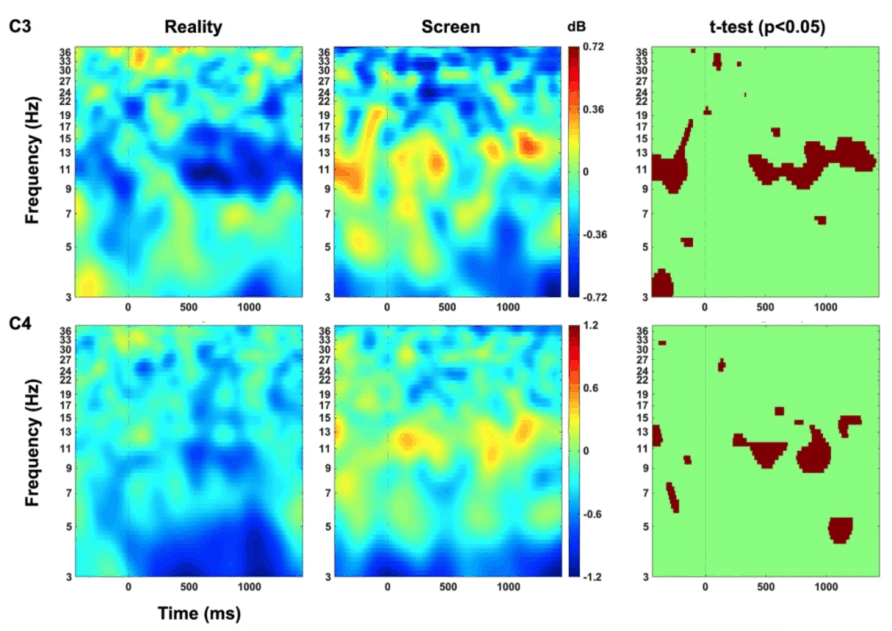
We have published a paper titled 'Differences in Mu rhythm when seeing grasping/motor actions in real context versus on screens' in the journal Scientific Reports. Seeing others doing motor actions modulates our brain processes. This work was aimed to learn how the Mu rhythm of viewers differs when seeing motor actions made with the hands in a screened movie vs. through a real performance.
Abstract
Mu rhythm (∼8–12 Hz) in the somatosensory cortex has traditionally been linked with doing and seeing motor activities. Here, we aimed to learn how the medium (physical or screened) in which motor actions are seen could impact on that specific brain rhythm. To do so, we presented to 40 participants the very same narrative content both in a one-shot movie with no cuts and in a real theatrical performance. We recorded subjects’ brain activities with electroencephalographic (EEG) procedures, and analyzed Mu rhythm present in left (C3) and right (C4) somatosensory areas in relation to the 24 motor activities included in each visual stimulus (screen vs. reality) (24 motor and grasping actions x 40 participants x 2 conditions = 1920 trials). We found lower Mu spectral power in the somatosensory area after the onset of the motor actions in real performance than on-screened content, more pronounced in the left hemisphere. In our results, the sensorimotor Mu-ERD (event-related desynchronization) was stronger during the real-world observation compared to screen observation. This could be relevant in research areas where the somatosensory cortex is important, such as online learning, virtual reality, or brain-computer interfaces.
We conclude that the fact that the Mu rhythm differs in real environments compared with screened contexts suggests that it may be of interest to be taken into account in designing research and industrial protocols based on reality perception and brain activity.
Andreu-Sánchez, C., Martín-Pascual, M.A., Gruart, A. and Delgado-García, J.M. (2024). ‘Differences in Mu rhythm when seeing grasping/motor actions in real context versus on screens’. Scientific Reports, 14: 22921.
SHARE THIS PAGE!